
Every Portfolio Is a Macro Portfolio


Most investors do not think of themselves as macro investors. They own stocks and bonds, perhaps real estate and a business, and they leave interest rates, currencies and the world economy to economists.
An investor who owns predominantly American stocks has made a series of decisions about the world, whether or not anyone made them on purpose. An investor concentrated in artificial intelligence and technology stocks has tied a portion of their wealth to a capital investment cycle that can turn as interest rates rise, financing conditions tighten or expectations for returns on that investment change. An investor who owns long-term bonds has taken a position on the future path of inflation and interest rates. An investor who owns commercial real estate depends on the availability and cost of capital, economic activity and the evolution of demand for physical space. These are not simply investments in different companies or asset classes. They are exposures to different underlying economic forces.
For many families, these exposures extend well beyond the investment portfolio. A business built in the United States, a home and other real estate, a career’s income and a lifetime of future spending all rest, to varying degrees, on the same economy and the same currency. An entrepreneur who owns a US operating company holds a large, undiversified position in American growth before buying a single stock. The investment portfolio is often the most flexible part of the balance sheet through which that position can be balanced.
The question is not whether an investor should take a view of the world economy. Every investor already has one embedded in their portfolio. The question is whether that view is understood, intentional and appropriate as the world changes.
A Way of Reasoning, Not a Product
A global macro lens starts with the economy and works outward to prices. A stock picker starts with a company. A macro investor starts with the forces that shape the price of nearly everything: growth and inflation, money and credit, and government policy. But understanding the economy is only half the discipline. The other half is understanding what markets already expect. A strong economy can be a poor investment, and a struggling economy can present an opportunity. What matters is the relationship between economic conditions, market expectations and the price an investor pays.
The word global matters as much as the word macro. Japan can be raising interest rates while Europe cuts them. Commodity exporters can prosper while importers struggle. One economy can be emerging from a period of excessive investment while another is beginning one. The opportunity, and the risk, lives in understanding those differences.
For many people, global macro brings to mind hedge funds, leverage and speculation. None of that is required. At its core, global macro is a way of reasoning about investments in the context of the world around them. The same principles can govern a family’s capital over generations as readily as they can inform an institutional investment manager.
The World Moves in Cycles
The modern global macro discipline took shape during a period of profound economic change. Under the postwar Bretton Woods system, major currencies were pegged to the dollar, and the dollar was convertible to gold at $35 an ounce. In August 1971, the United States ended that convertibility, and within two years most major currencies were floating. Exchange rates became independent sources of investment risk and opportunity, and monetary policies could increasingly diverge across countries.
The practitioners who helped define the field emerged during this period. Ray Dalio founded Bridgewater in 1975 around the interaction of growth, inflation and credit. Paul Tudor Jones founded his firm in 1980 and became known for studying historical market patterns, most famously the parallels between 1929 and 1987. What distinguished these approaches was a recognition that economies and markets do not evolve in straight lines. They move through cycles.
Business and monetary policy cycles unfold over years, while credit, currency and capital investment cycles can span decades. Structural forces such as demographics, technological innovation and productivity growth operate over even longer horizons. These forces overlap, reinforce and sometimes work against one another. Even an industry benefiting from decades of rising demand can suffer from excessive investment and falling profitability. An investment’s attractiveness depends not only on its long-term prospects, but also on where it stands in its economic and valuation cycles.
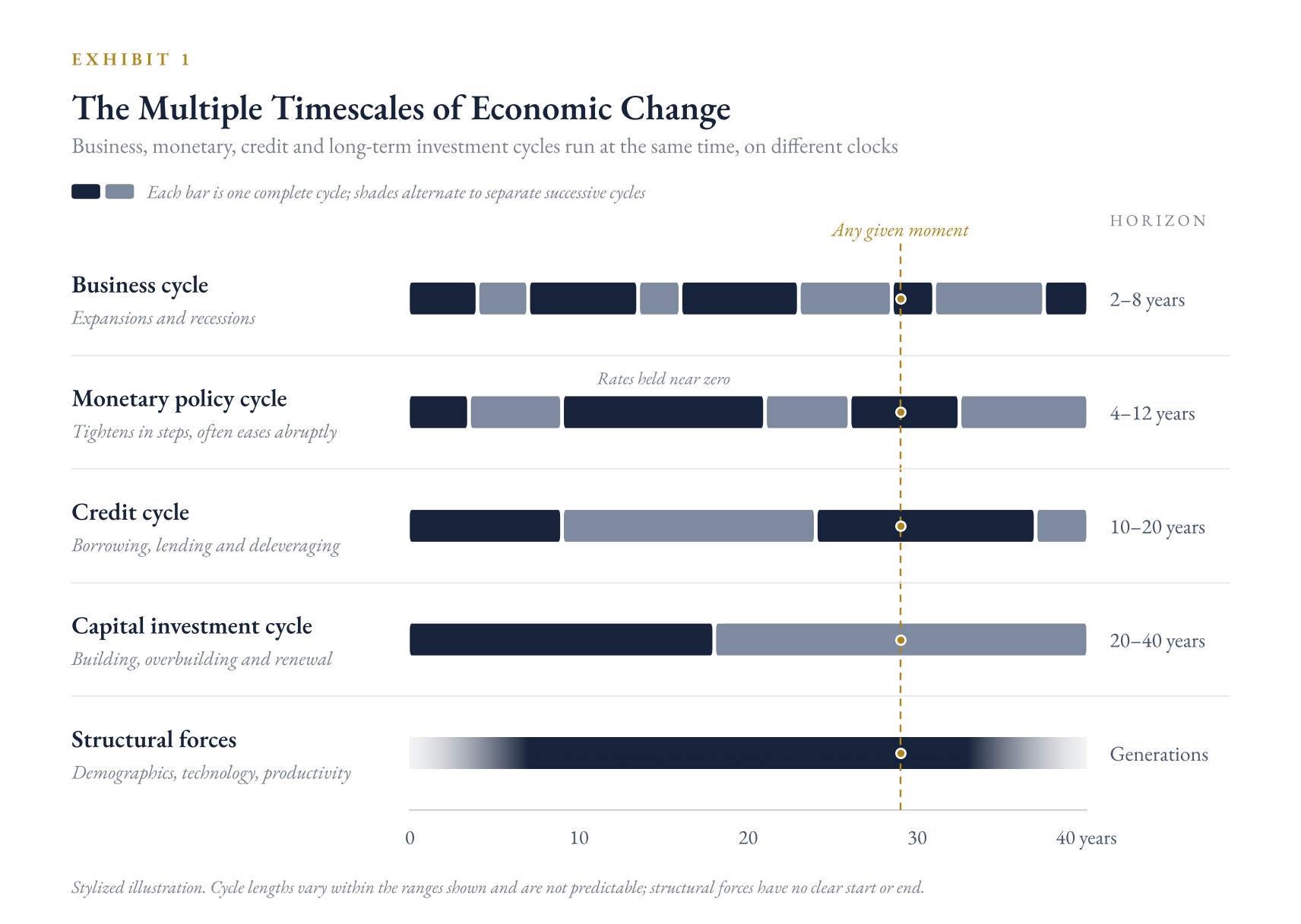
The defining episodes of modern financial history share a pattern. The Plaza Accord of 1985 marked a turning point in a period of exceptional dollar strength. Britain’s departure from the European Exchange Rate Mechanism in 1992 exposed the tension between domestic economic conditions and exchange-rate commitments. Thailand’s currency peg collapsed in 1997, and the crisis spread across Asia. In 2008, a US housing and credit cycle became a global banking crisis. Each time, an arrangement that appeared durable proved temporary. The lesson is not that investors should anticipate every turning point, but that the conditions under which investments have prospered should never be assumed permanent.
When the World Moved Together
The decade following the global financial crisis illustrates how an economic regime can shape investment outcomes and, eventually, investor expectations. Across much of the developed world, inflation remained subdued and central banks maintained historically low interest rates. The European Central Bank’s deposit rate remained negative from 2014 to 2022. Despite important differences among economies, a common monetary environment increasingly influenced the pricing of financial assets around the world. (Reference)
The United States was particularly well positioned to benefit. American companies earned exceptional profits, technological innovation accelerated, and deep capital markets attracted global investment. Declining discount rates favored companies whose valuations depended on earnings expected far into the future. A strong dollar further enhanced the relative performance of domestic investments for American investors. The United States accounted for under 30 percent of global equity markets in 1988 and approximately 42 percent in 2010. By the mid-2020s, it represented roughly two-thirds of the MSCI All Country World Index. The ten largest stocks in the S&P 500 accounted for approximately 40 percent of the index. (References)
These developments reflected genuine American strengths, amplified by a particular economic regime. Structural advantages such as innovation, productivity and access to capital can persist for decades. The monetary conditions, currency movements and valuation changes that amplify their investment returns may not.
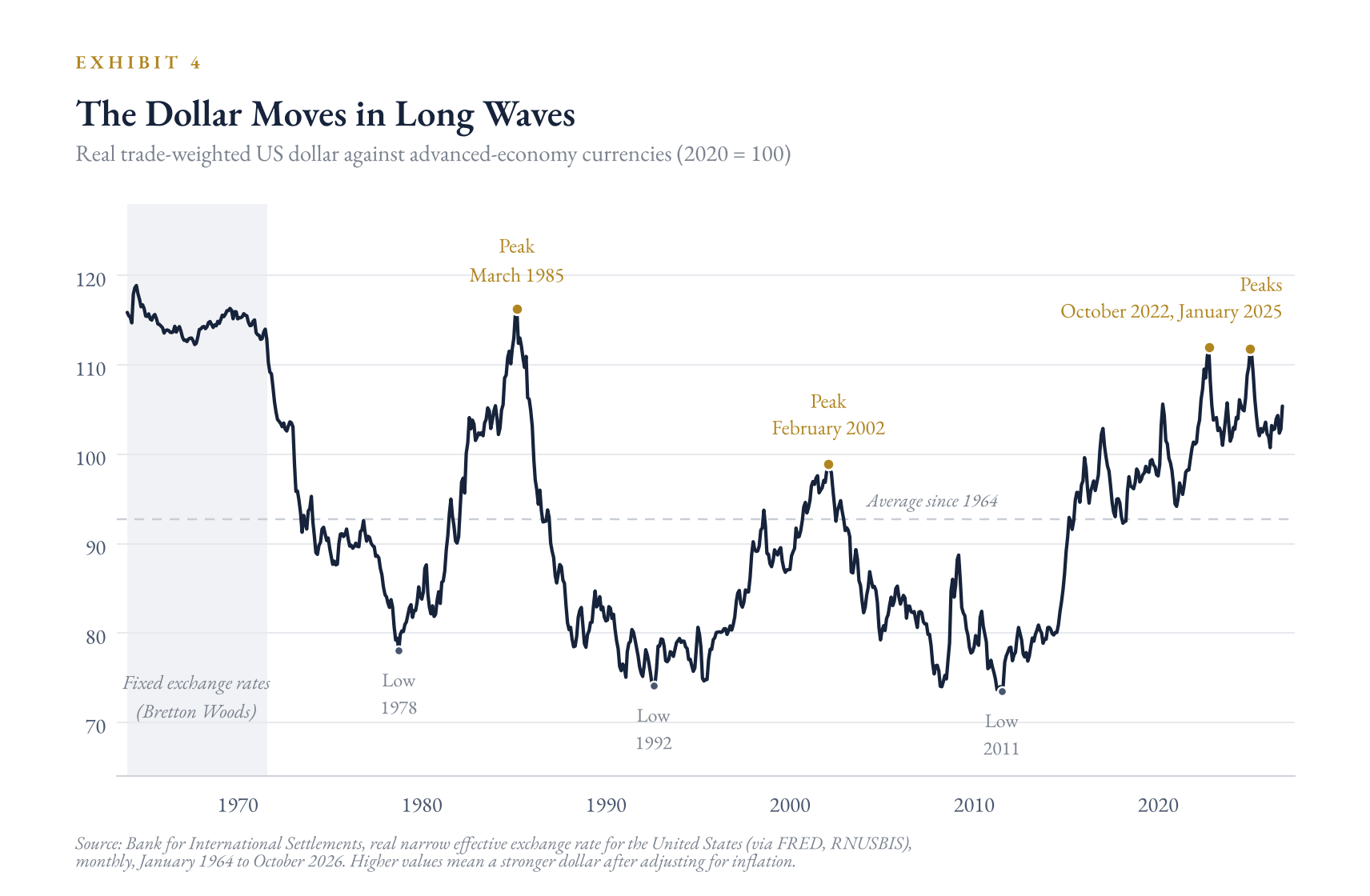
Equity market leadership has rotated before: abroad in the 1970s and 1980s, at home in the 1990s, abroad in the 2000s, and at home through the 2010s. Currency markets exhibit similar patterns, with major peaks in the dollar in 1985, around 2002 and early 2025. Each wave lasted long enough to feel permanent. (References). One of the challenges of investing is separating the enduring characteristics of an attractive investment from the temporary conditions that have made it particularly rewarding.
When the World Moves Apart
The economic environment that emerged after the pandemic challenged several assumptions formed during the preceding decade. Inflation returned as an important variable as supply chain dependencies were revealed and deglobalization became a national security issue. Central banks increasingly faced different domestic economic conditions, while governments assumed a more prominent role in directing investment.
The Bank of Japan began raising interest rates in 2024 after decades near zero. Germany loosened its constitutional debt brake in 2025 to fund defense and infrastructure, departing from a longstanding tradition of fiscal restraint. The United States has been running large deficits even during an economic expansion. Budgets, not only central banks, move interest rates and currencies. (References) Trade and geopolitics are also redrawing the map. Tariffs and supply-chain shifts change which economies benefit from trade. Energy shocks affect commodity importers and exporters in opposite directions.
Economists call the variation among economic outcomes dispersion. Growth, inflation, monetary policy and investment activity can all exhibit dispersion across countries. Greater economic dispersion does not automatically create better investment opportunities. Those differences may already be reflected in asset prices. But an economy emerging from years of underinvestment presents a different set of opportunities and risks from one experiencing an investment boom and elevated valuations.
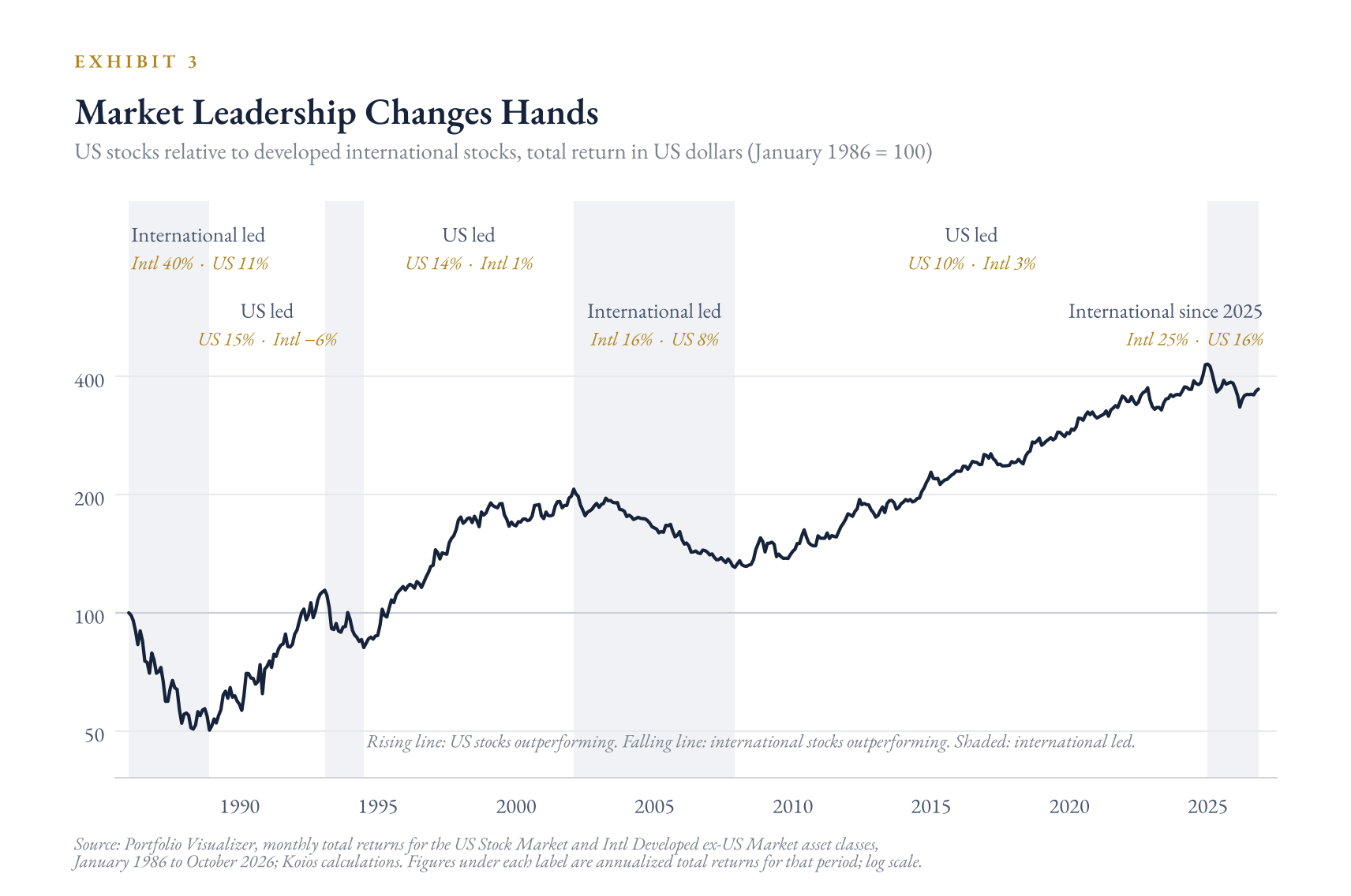
This is not an argument to sell America. The United States retains considerable structural advantages, and international markets carry their own economic, political and currency risks. The argument is that the conditions under which investments prosper differ across countries and change over time. A global perspective allows investors to consider not only how much risk they should take, but which economic risks they should own and where they are being adequately compensated for owning them.
Diversifying Assets Is Not the Same as Diversifying Risk
As economic conditions diverge and market relationships evolve, an important question emerges: what, precisely, is a portfolio diversifying? Consider a portfolio that owns American equities, technology companies, commercial real estate, private equity and long-term government bonds. By conventional measures, it is diversified across asset classes and potentially hundreds of individual securities. Yet many of these assets benefit from the same economic conditions: declining interest rates, abundant liquidity and rising valuations. If those conditions reverse, investments that appeared diversified may respond in surprisingly similar ways.
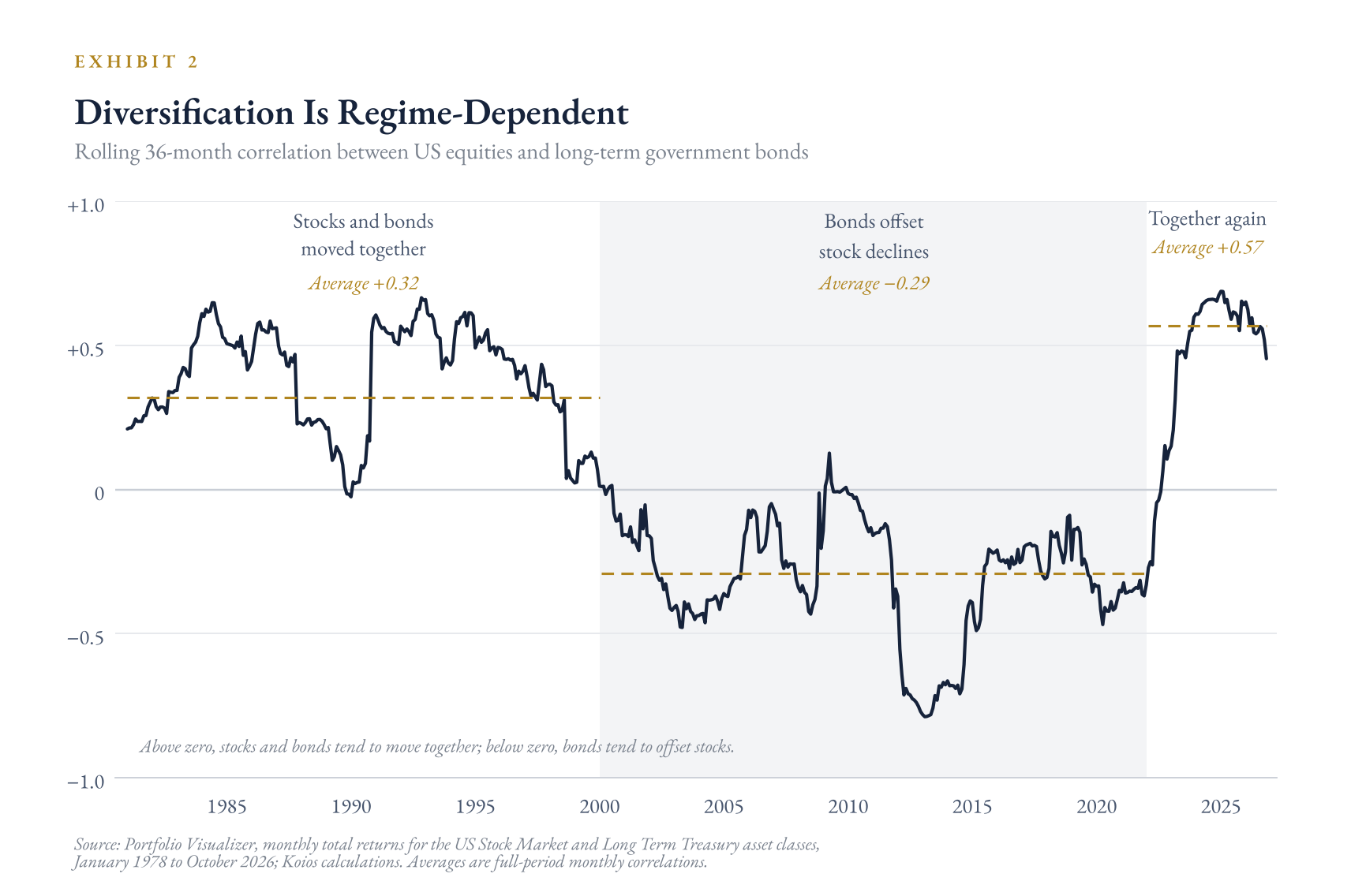
For much of the period following the global financial crisis, government bonds provided an effective counterbalance to equity market weakness. Inflation remained subdued, and central banks could respond to deteriorating growth by lowering interest rates. When stocks fell, bonds often rose. In 2022, persistent inflation forced central banks to raise interest rates despite weakening financial markets. Stocks and bonds fell together. The assets had not fundamentally changed. The economic conditions governing their relationship had. Correlations measured during one economic regime may provide an incomplete picture of how investments will behave in another.
A macroeconomic perspective asks a different set of questions. How much of a portfolio depends on sustained economic growth? How much depends on low inflation, inexpensive credit or a strong dollar? What happens when those conditions change? The objective is not to eliminate these exposures. They are fundamental to earning investment returns. It is to understand them and determine whether a portfolio depends too heavily on any particular economic outcome.
Constructing Portfolios for an Evolving World
If economies and markets continually evolve, what does that imply for portfolio construction? The investment opportunity set should be broad. Growth, innovation and economic transformation are not confined to one country or asset class. Diversification should be understood in economic terms. The number of securities in a portfolio tells us less than the underlying forces on which their returns depend. Valuations should be evaluated in the context of cycles. The long-term merits of an investment cannot be separated from the price paid or the expectations embedded in that price.
And portfolio construction should be adaptive.
This does not mean reacting to every economic release or attempting to anticipate every market correction. Economic cycles are uncertain, and even well-founded investment judgments can prove premature or incorrect. Rather, an adaptive discipline recognizes that exposures appropriate for one economic environment may not be equally appropriate for another. A long investment horizon does not require an unchanging portfolio. In many respects, it makes understanding change more important.
For families, this process begins with the whole balance sheet. A business owner’s industry exposure, the geographic concentration of real estate holdings and the currency in which future obligations are denominated all have implications for how financial assets should be invested. There is no universally correct portfolio. What matters is that its economic exposures are chosen rather than inherited.
How We Look at the World
Our own perspective on markets began with academic research into long-run cycles in commodity prices. These cycles reflect a fundamental economic reality: supply and demand adjust at different speeds. Periods of scarcity encourage investment. Investment eventually increases supply. Abundant supply depresses prices and discourages further investment, creating the conditions from which the next cycle may emerge. The same principle extends well beyond commodities. Credit, currencies, real estate, equity markets and entire economies respond to economic incentives and constraints that evolve over time.
We look across asset classes because economic risks do not respect the conventional boundaries between them. We look across countries because economies do not all move through their cycles at the same time. And we evaluate investments across multiple horizons because short-term economic conditions and long-term structural trends can lead to very different conclusions. The objective is not to predict the future with certainty. It is to understand the forces shaping investment outcomes, evaluate the expectations reflected in market prices, and allow portfolios to evolve as the evidence changes.
Every portfolio is a macro portfolio. Some are constructed with that understanding, and others are not. We believe that understanding the economic exposures a portfolio contains, and deliberately choosing how those exposures evolve, is fundamental to the long-term stewardship of capital.
Disclosures
Koios Private Family Offices, LLC is an Iowa-registered investment adviser. Registration does not imply skill or training. This general educational material is not individualized advice or a recommendation. Company and sector references are illustrative, not complete analyses. Koios may hold discussed securities in client accounts. Past performance and forecasts do not guarantee future results. Advisory services are offered only where Koios is appropriately registered, notice-filed, exempt or excluded. References to indexes, markets, firms and individuals are for illustration only; indexes are unmanaged and cannot be invested in directly. Data from third-party sources are believed to be reliable but are not guaranteed. Past performance is not indicative of future results. All investing involves risk, including the possible loss of principal. International investing involves additional risks, including currency fluctuation, political and economic instability, and differences in accounting standards. Diversification does not assure a profit or protect against loss in declining markets. No investment approach can guarantee successful outcomes.




Built for Depth
2600 Grand Avenue, Suite 290
Des Moines, IA 50312